
What It Takes to Become a Safari Horse at Okavango Horse Safaris

I once had a horse that refused to walk over zebra crossings - now we have horses that need to gallop alongside actual zebra!
It still feels slightly surreal writing that sentence.
Back in England, so much of horse training revolves around helping horses cope with modern life. Plastic bags, traffic, dogs, banners, wheelie bins and the occasional rogue pheasant all become part of the process. Here in Botswana’s Okavango Delta, the lessons are rather different.
Safari horses must learn how to move calmly through one of the wildest and most wildlife rich landscapes on earth.
At Okavango Horse Safaris, training a safari horse is never simply about bravery. It is about trust, patience, instinct and partnership. Horses learn to navigate water channels and floodplains, stand quietly while elephants pass nearby and eventually canter across open grasslands alongside zebra and wildebeest.
But none of this happens overnight.
Young horses begin slowly, usually joining rides alongside older, experienced safari horses who quietly teach them how to behave in the bush. The herd becomes everything. Youngsters watch the older horses constantly, taking reassurance from their reactions and learning which situations require calmness and which require caution.
The Okavango Delta itself plays a huge role in shaping them. Unlike horses working within fences and arenas, safari horses must constantly assess changing terrain, sounds, scents and wildlife movement. Every day is different.
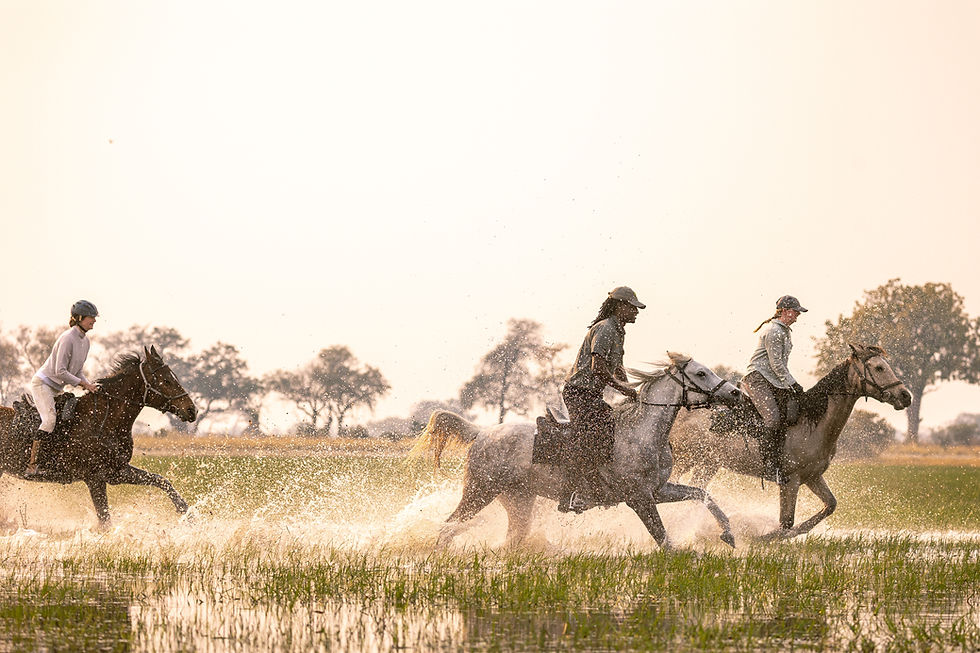
One of the first major lessons is water. Depending on the season, horses may spend hours moving through shallow floodplains, crossing channels or swimming between islands. For some young horses this feels entirely unnatural at first, but over time they learn to trust both the other horses and their rider.
Then comes wildlife.
Zebra are often one of the earliest introductions, not because they are dangerous, but because they are visually and instinctively confusing to horses. Their scent, movement and appearance are unfamiliar and highly stimulating. Young safari horses gradually learn not only to tolerate them, but to move quietly among them without tension.
Later come giraffe, buffalo, wildebeest and elephant. Lion are treated very differently.
Often the horses know they are nearby long before we do. You can feel it pass quietly through the ride. Heads lift. Ears sharpen. The atmosphere changes. Experienced safari horses help younger ones learn how to react without panic and how to trust the calmness of the group around them.
This relationship between horse and herd becomes especially important on our new fly camp experience, where guests ride deeper into the Delta before spending the night under canvas in a quieter and more remote corner of the concession.
For the horses, camp life itself forms part of the training.
Young horses must learn to stand tethered calmly beside other horses through the night without kicking, pulling or becoming anxious. They hear hyena calls, shifting wildlife around camp and the unfamiliar sounds of canvas moving in the wind. They learn patience, awareness and how to settle within the rhythm of camp life.

A safari horse is not simply trained to ride. It learns how to live out here.
And life here is unlike almost anywhere else in the equestrian world.
Days can involve weaving through palm islands, splashing through floodplains, standing silently while elephant cross ahead or cantering through open grasslands as red lechwe scatter through the water nearby.
Over time, many safari horses become incredibly emotionally balanced. There is little artificial pressure here. No indoor arenas. No loudspeaker systems. No endless circles. Instead, horses spend much of their lives moving naturally through open landscapes within a herd structure that encourages confidence and communication.
You cannot force a horse through this environment. The relationship has to come first. If they trust you, they will try incredibly hard for you.
For many riders visiting from overseas, watching a safari horse calmly approach a herd of zebra or stand quietly while elephant move through nearby bush can feel almost unbelievable.
But perhaps that is the point.
These horses are not fearless machines. They are prey animals learning, adapting and building trust within one of the wildest ecosystems left on earth. Every calm crossing, every quiet approach to wildlife and every night spent tethered beneath African skies is earned slowly through experience, patience and the reassurance of the other horses around them.


Comments